Early in every real estate transaction, the title commitment arrives. It is one of the most important documents in the file, and for newer agents and busy mortgage teams, it can look dense at first glance.
Here is the simplest way to think about it: a title commitment is the title insurance underwriter’s promise to insure the property, issued through a title agent such as AtoZ. That promise holds as long as certain conditions are met, and it comes with certain items excluded. Once you know what each section does, the commitment becomes one of the most useful tools you have for keeping a closing on schedule.
In Plain English
A title commitment answers three questions:
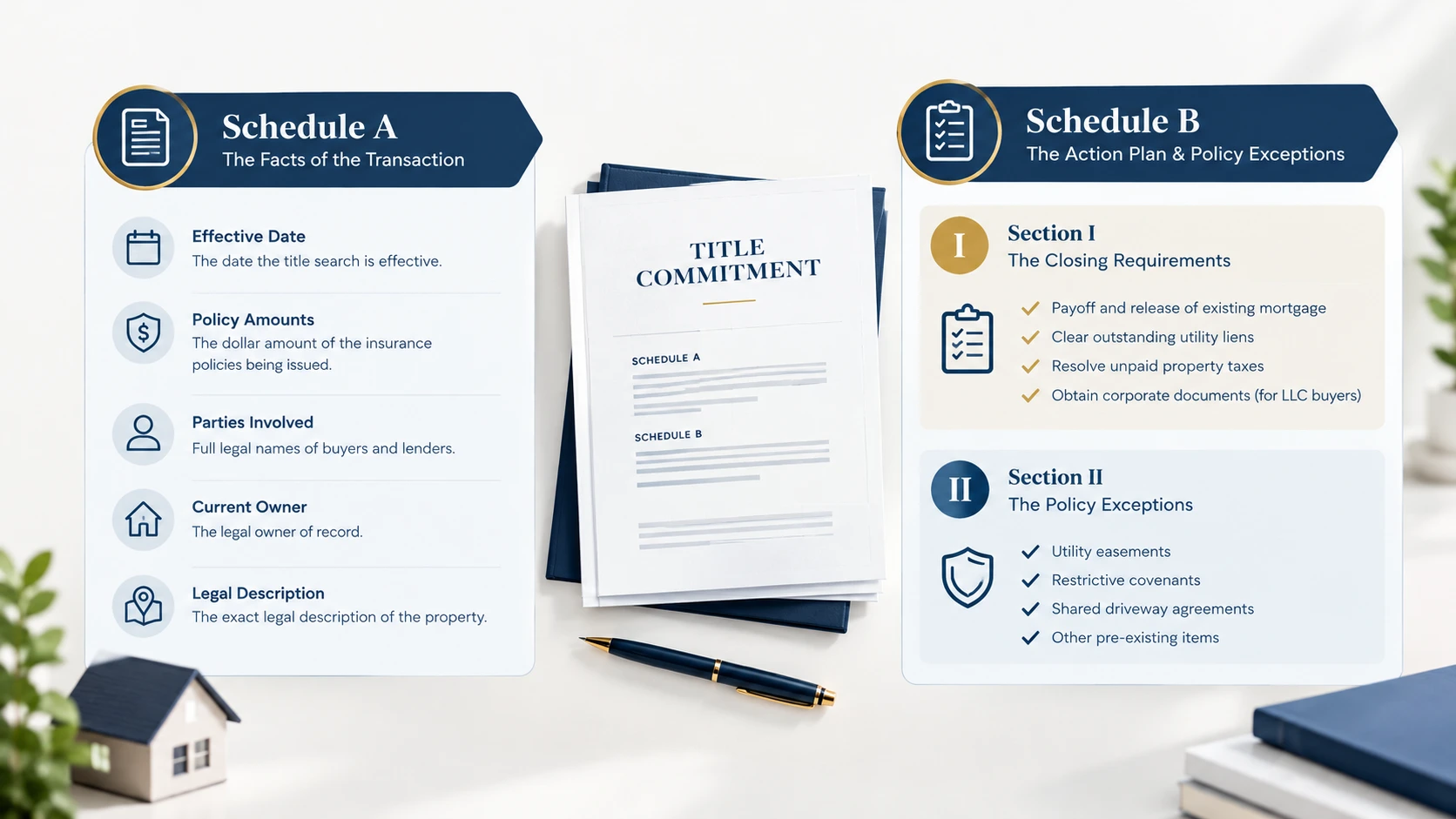
Schedule A: What is being insured, for whom, and for how much?
Schedule B, Section I: What needs to happen before closing?
Schedule B, Section II: What will the policy not cover?
1. Schedule A: The Facts of the Transaction
Schedule A is the summary page. It confirms the core details of the transaction, including:
Why it matters: Lenders compare Schedule A against the loan file. A misspelled name, an outdated loan amount, or a legal description that does not match can hold up loan approval. Catching these details early keeps every party aligned.
Quick tip: When the commitment arrives, confirm that every name matches the contract exactly, including middle initials and LLC or trust names.
2. Schedule B, Section I: The To-Do List Before Closing
If Schedule A lists the facts, Section I of Schedule B is the checklist. These are the requirements that must be resolved before the deal can close and the title policy can be issued. Common examples include:
Why it matters: Each of these items takes time. A payoff letter or lien release requested the week of closing can push the date. At AtoZ, our processors review these requirements as soon as a file opens, so payoffs and releases are in hand well before the Closing Disclosure is finalized.
3. Schedule B, Section II: What the Policy Will Not Cover
Section II lists the exceptions. These are items already attached to the land that stay with the property after the sale, so the title policy does not insure against them. Common examples include:
Why it matters: Most exceptions are routine. Still, they are worth a close look to make sure none of them conflict with the buyer’s plans, such as adding a fence, a pool, or an addition where an easement runs. Because we manage every file in Qualia, we can share these documents with all parties early, so there are no surprises at the closing table.
How AtoZ Helps
Reading a title commitment well is one of the best ways to protect a transaction from last-minute delays. At AtoZ Title & Settlement, we make that process easier for every partner we work with:
Ready to Move Forward With Confidence?
We are here to help. Whether your transaction brings you to our offices in Maryland, Virginia, DC, or Florida, our team is ready to keep your closings on track and your clients confident from contract to closing.
Call us at (888) 615-2869 or visit atoztitle.com.
AtoZ Title & Settlement Team