
By the AtoZ Title & Settlement Team
During the preparation for a real estate closing, mortgage lenders and real estate agents frequently review the initial title commitment with their clients. A common point of confusion that arises for newer professionals and their clients is the distinction between the two primary types of title insurance policies issued at settlement: the owner’s policy and the lender’s policy.
Understanding how these distinct insurance products operate is essential for protecting the interests of everyone at the closing table. While both policies stem from the same historical land records search, they protect entirely different financial interests.
Mastering this explanation builds client confidence and prevents closing-day friction. By explaining the differences clearly, you help your clients understand why both policies matter and why they are both essential investments in a secure transaction.
A breakdown in explaining these coverages can lead to last-minute friction or misunderstandings regarding closing costs. By mastering the differences between these policies, real estate professionals can ensure clear communication throughout the transaction. Here is an analysis of how both policies function and why they are both critical to a successful transaction.
1. The Mandatory Requirement of the Lender’s Title Insurance Policy
A primary point of confusion involves why a title insurance policy is required when a buyer is already paying for a title search. For virtually every institutional mortgage loan, banks and underwriters require a lender’s title policy as a non-negotiable condition of funding. This policy ensures the financial institution holds a valid, first-priority lien on the property.
The Functional Mechanics:
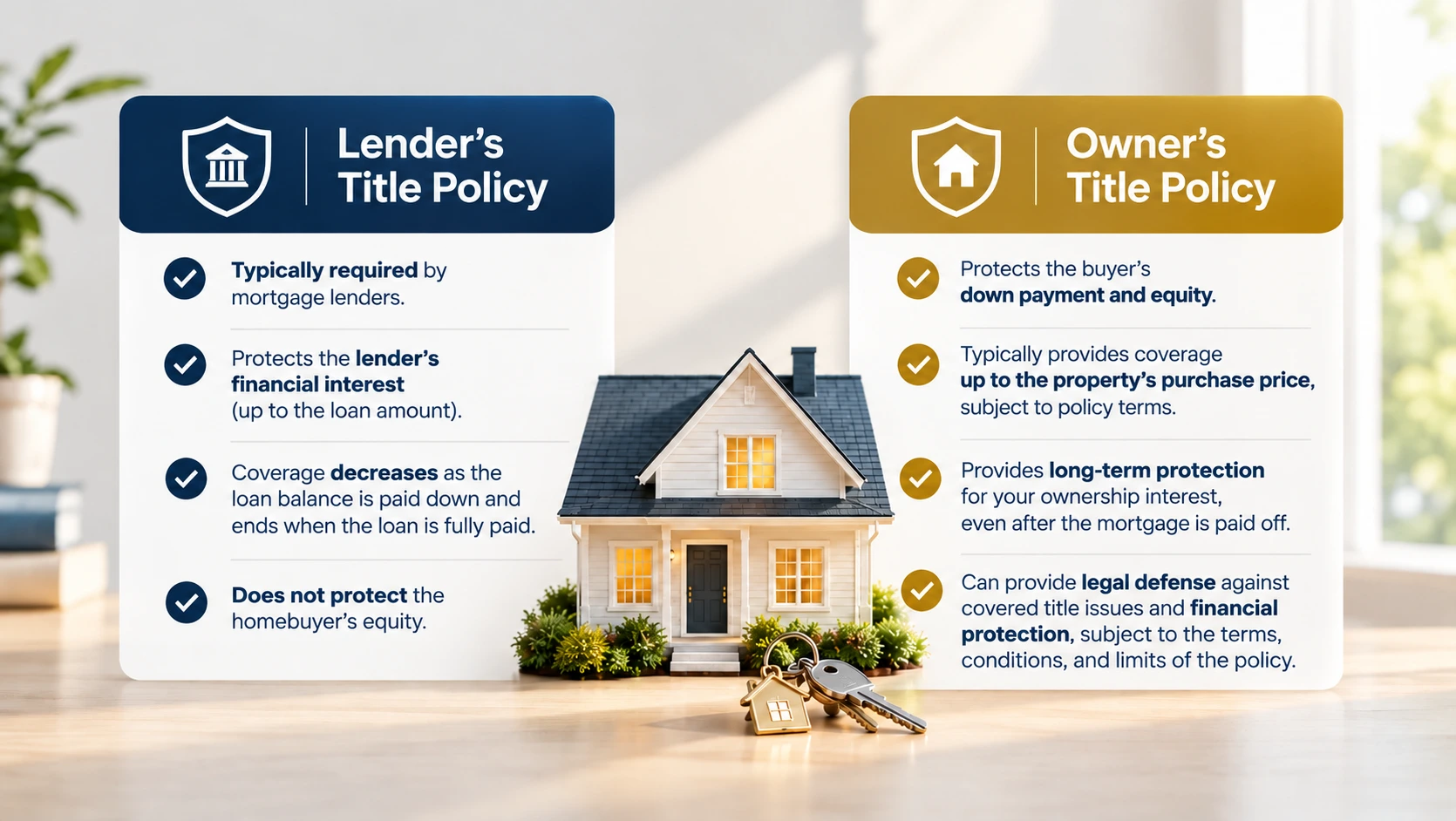
The lender’s title policy specifically protects the financial institution against loss up to the outstanding dollar value of the mortgage loan. If a hidden title defect, such as an unreleased mortgage from a previous owner, arises after closing (post-settlement), the lender’s policy insures the bank’s investment. However, this coverage declines as the loan balance is paid down and completely terminates once the mortgage is fully satisfied. Crucially, it provides zero legal defense or financial protection for the equity of the homebuyer.
2. The Comprehensive Protection of the Owner’s Title Insurance Policy
Because the lender’s policy only shields the bank, a separate policy must be issued to protect the person purchasing the home. The owner’s title policy covers the full purchase price of the property, securing the buyer’s down payment and equity against hidden legal challenges.
The Functional Mechanics:
Unlike the lender’s policy, which fluctuates with the loan balance, the owner’s policy remains active for as long as the buyer or their heirs retain an interest in the property. If an undiscovered ownership discrepancy, missing heir claim, or recording error emerges years down the road, the title insurance company provides full legal defense costs and covers financial losses up to the face value of the policy. Proactive settlement firms ensure that real estate agents are equipped with easy-to-understand reference resources to explain this long-term security to their buyers early in the process.
Why This Matters for Agents
When you explain to buyers that their owner’s policy provides lifetime protection while the lender’s policy only protects the bank’s interest, you are setting accurate expectations and building trust. Clients who understand these distinctions feel more confident moving toward closing. This knowledge also positions you as a trusted advisor rather than someone simply moving through the transaction checklist.
3. Maximizing Savings via the Simultaneous Issue Rate Workflow
A common closing cost bottleneck occurs when clients express concern over the combined cost of paying for two separate title insurance premiums. If these fees are not explained transparently during the preliminary loan estimate review, it can lead to confusion when balancing the final closing disclosure.
The Solution:
Clear communication and strategic software integration allow title teams to apply a significant cost-saving measure known as a simultaneous issue rate. When both the lender’s and owner’s policies are purchased together at the same settlement, the title company issues the lender’s policy at a deeply discounted nominal rate. Utilizing advanced transaction management software, such as processing the file directly in Qualia, ensures these complex premium rates are calculated automatically and balanced early. This prevents last-minute mathematical corrections and keeps the closing timeline perfectly on track.
Partnering for Seamless Clearances
Educating your clients on the value of title insurance builds long-term professional credibility. When real estate agents, mortgage originators, and escrow teams work together to demystify closing requirements, the journey from contract to closing becomes a routine celebration. Our experienced team remains dedicated to protecting your professional reputation, preserving your partner relationships, and keeping your real estate transactions on schedule.
When your transaction has a dedicated processor from contract to closing, communication is clear, accountability is built in, and nothing falls through the cracks. Whether your transaction brings you to our offices in Tysons, VA; Fairfax, VA; Richmond, VA; Rockville, MD; West Palm Beach, FL; or Washington, DC, each agent and lender receives a dedicated processor for a truly personalized title experience.
Behind every smooth closing is a dedicated team managing details with precision. With over 1,200 successful closings in under four years and a 92.5 percent year-over-year client retention rate, AtoZ Title & Settlement has earned the trust of agents and lenders across Virginia, Maryland, DC, and Florida. We know what it takes to protect transactions.
Ready to partner with a team that prevents delays before they happen? Reach out to AtoZ Title & Settlement at (888) 615-2869 or visit www.atoztitle.com. We serve real estate professionals across Virginia, Maryland, Washington DC, and Florida, and we are committed to keeping your transactions on track and your clients confident from contract to closing.